The Bigger Picture
David Volek, Twenty Years Later
by Maher S. Hoque on Jan.29, 2013, under Basketball, College Basketball, College Football, Football, Hockey, Pro-Football, The Bigger Picture
Every time the Penguins play the Islanders, as they’re doing tonight, I can’t help but remember David Volek. Oh the name conjures memories of infamy, it does. It was Volek’s slapshot in Game 7 of the 1993 NHL playoff series between the Pens and Islanders that denied Mario Lemieux and company the chance at a three-peat.
It pains us, it does. It burnsss. It freezessss. Volek’s goal places him among the top sports villains of my life.

Not as high as Scottie Reynolds. But higher than Alfred Pupunu. Maybe in the same vein as Mardy Gilyard or Larry Brown (the Cowboys DB) , though Brown’s misdeeds against my sporting life were in a higher stakes game.
There would be no dynasty for the Pittsburgh Penguins of Mario Lemieux. They continued to be among the top teams for many years afterwards but looking back now, damn, that team should’ve won that third Stanley Cup! If not for David #$%^@ Volek.
I suppose with the Superbowl coming up, I should name Ray Lewis or Ed Reed in the list. Long and storied careers full of antagonism but to my recollection, neither have a signature, defining play that cuts so deep. They would likely go on a different list.
No one will likely ever supplant Francisco Cabrera though.
The ACC is a Better Fit for Pitt
by Maher S. Hoque on Nov.20, 2012, under Basketball, College Basketball, College Football, Football, The Bigger Picture
For years after the ACC first raided the Big East for Miami and Virginia Tech, Pitt partisans dreamed of a move to the Big Ten. TV markets, however, dictated that Pitt would/will never get an invite. The Big Ten Network is already in the Pittsburgh area because of Pennstate. Ratings themselves don’t necessarily matter. If you have expanded cable, you get the BTN whether you watch it or not. So you’re paying for it no matter what. The B1G gets paid, period. I still prefer the ACC.
In football, we can still maintain a strong northeastern and mid-atlantic presence against former Big East schools Syracuse, BC and VT. We get a better toehold in Florida with the additions of games against FSU and resumption of games against Miami-FL. We can expand our recruiting south to places like the Carolinas. And historically, Pitt hasn’t needed a rivalry presence to recruit Ohio; the River City Rivalry with Cincinnati stretches back less than a decade. Moving to the B1G would open up the midwest more but that’s about it.
There’s no doubt that Big Ten schools have more aggregate football success and tradition at the top than the ACC. OSU, Michigan, Nebraska and Pennstate are among the blue-bloods of collge football. But the ACC still has two blue-blood brands of its own in FSU and Miami-FL and two barons (so to speak) in Clemson and VT.
In basketball, the advantage is clear. In either scenario, B1G or ACC, Pitt loses the access to Madison Square Garden that the Big East provided. But one of the biggest false narratives about Pitt basketball is our supposed reliance on NYC talent. In Ben Howland’s early days, that was certainly true but Jamie Dixon has broadening our recruiting during his tenure, expanding into DC/MD area. The best Pitt team of the past two decades, the 2008-2009 Elite Eight team, had only two players from NYC prep schools (three if you count Don Bosco Prep, which I don’t). Sam Young, one of the most dynamic players on that Pitt team, came from Maryland. As Pitt’s talent level has slowly improved, Dixon’s need to rely on under-talented grinders from NYC has diminished.
Institutionally, Pitt fits equally well in the ACC and Big Ten. We’re a major research university. We’re part of the AAU. Our endowment of $2.5 billion would be the third highest in the B1G, fourth highest in the ACC (if you include ND).
In terms of our enrollment, Pitt would be one of the smallest schools in the Big Ten, third from the bottom. In the ACC, we’re right in the middle. Don’t think that enrollment doesn’t factor into a school’s ability to fill its stadia. When it wins, Pitt can/will fill Heinz Field because the city is also along for the ride. When it loses, well, it looks like Byrd Stadium at Maryland.
Ultimately, money talks. For Rutgers, this move absolutely makes sense when the alternative is staying in a sinking Big East ship. But for Maryland, outside of the money, it’s a bad, bad decision. The same would have gone for Pitt.
You Never Should Have Been
by Maher S. Hoque on Jul.24, 2012, under College Football, Football, The Bigger Picture
Yesterday when the NCAA announced its sanctions on the Pennstate football program, I watched Facebook, Twitter, ESPN.com article comments and other sources to gauge the reactions of Pennstaters to this apparently devastating hit to their once-proud football program.
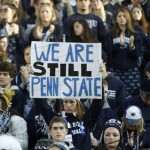
I’m not sure I read anything from a Pennstater agreeing with the penalties. Not a one. Many said that the full story hadn’t been written, that the NCAA should have waited until the trials of Spanier, Curley & Schultz had laid out more evidence. A few continued to stress that the NCAA had no jurisdiction to sanction the football program. Some concentrated their wrath on the media for its supposed feeding frenzy. Others lashed out at the current administration for copping out to the NCAA. And so many many others simply screamed into the void, “We are [still] Pennstate!”
I have to ask, what penalties, if any, would they have accepted as fair? 2-year bowl bans, 5 scholarship reductions/year, no monetary fine? Only a monetary fine? More NCAA oversight? Or perhaps, nothing.
Surely, nothing better is going to come to light after the verdicts for Messrs Curley, Spanier and Schultz. Joe Paterno is not going to be magically exonerated. The culture of Pennstate’s all-power, all-encompassing football institution, whose power engendered this cover-up, won’t be seen in a softer light. And make no mistake about it, Pennstate football was and is an institution, not just a program.
I don’t think the public can be expected to believe Pennstate’s own proclamations that it’s reforming its culture and so should be left alone. Oh so, Curley, Spanier and Schultz are gone or placed on leave. Paterno was fired. Maybe the Board of Trustees will be the next to go. Well bully for yinz gahz.
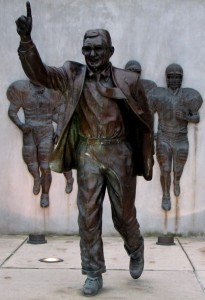
Every measure taken that even tangentially touched the football program or the culture that Paterno fostered has been fought. Fire Paterno – riots. Take down the Paterno statue and people go nuts. Rename Paternoville to Nittanyville and Facebook explodes. The Freeh report itself was commissioned by PSU’s own administration and many Nitters still don’t believe it, whether about Paterno or the football institution.
We (myself included) trusted Pennstate for decades that their “success with honor” motto was real and tangible; that the sanctimony, however annoying, might be earned. No more. Welcome to the club of ordinary universities, Pennstate. You don’t get the benefit of the doubt anymore.
The Big East Was Doomed Years Ago
by Maher S. Hoque on May.09, 2012, under College Football, Football, The Bigger Picture
Or… Why Joe Paterno is Laughing Himself Silly Down in Heaven
In the wake of Big East Commissioner John Marinatto’s (forced) resignation, there’s been a lot of revisionist history about what should have been done to strengthen the league. I don’t think anything substantive could have been done post-2004; certainly nothing that would have prevented further defections.
It’s been written that the conference dithered too much in the wake of the 2004 ACC defections. The additions of Louisville, Cincinnati and USF stabilized the league but that was it. UCF or Memphis might have been decent additions at the time but no available school would have radically shifted the balance of power nor provided the anchoring presence that the University of Miami once did.
A league needs an anchor tenant (or two) around which to build its brand. The ACC already had a high mid-level brand in Clemson and got an anchor tenant when they admitted Florida State in 1992. Prior to 2004, the Big East wasn’t the clear-cut worst BCS conference; it was relatively on par with the ACC in football and could have even tried to poach FSU and maybe UMD and UVA, two decent mid-level brands. But instead, the ACC acted boldly and snagged the Big East’s anchor tenant (Miami), a high mid-level brand (Virginia Tech) and a large market (Boston College).
So I would contend that the Big East as a major football league has been doomed to die a slow death since losing the Hurricanes. I, for one, am very relieved that Pitt is off that sinking ship.
Is Ice Hockey the “Best” Sport?
by Maher S. Hoque on Apr.25, 2012, under Baseball, Basketball, Football, Futbol/Soccer, Hockey, Misc, The Bigger Picture
Despite the pain and humiliation of watching my Pittsburgh Penguins lose their third consecutive post-season series, this time to the despicable Philadelphia Flyers, I am as convinced as ever that Ice Hockey is the best team sport out there.
I don’t necessarily mean most enjoyable, surely a subjective measure. Nor is the NHL the best sports league across all sports. I’ve come to the conclusion over the years that Ice Hockey calls for the greatest total abundance of every sports characteristic and skill. List out all the skills you want and Ice Hockey will score higher in aggregate.
Speed, physical toughness, endurance, coordination/reflexes, mental toughness, etc. etc. etc. The game even calls for moving backwards in a fundamental way that no other sport duplicates.
Here’s a rough chart ranking the major team sports:
| Baseball | Basketball | Am. FB | Rugby | Futbol | Cricket | Ice Hky | |
| Speed | 3 | 7 | 4 | 1 | 6 | 2 | 5 |
| Physical Toughness | 1 | 4 | 6 | 7 | 3 | 2 | 5 |
| Mental Toughness | 4 | 2 | 7 | 5 | 1 | 3 | 6 |
| Endurance | 1 | 3 | 4 | 6 | 5 | 2 | 7 |
| Reflexes/Coordination | 3 | 6 | 1 | 2 | 5 | 4 | 7 |
| Intelligence/Creativity | 1 | 5 | 4 | 3 | 7 | 2 | 6 |
| Versatility (!=specialization) | 1 | 6 | 2 | 5 | 4 | 3 | 7 |
| Total Score | 14 | 33 | 28 | 29 | 31 | 18 | 43 |
Before you get in a huff about these rankings, it should be noted that I have no animus against any particular sport. If I were to rate my enjoyment of each of these sports, it would be different from the rankings above. Just some food for thought.
MST: Duke and Coach K say yes to Pitt/’Cuse. Rest of ACC says NO!
by Maher S. Hoque on Sep.18, 2011, under Basketball, College Basketball, College Football, Football, MST, The Bigger Picture
The college sports world was thrown into turmoil this weekend when it was revealed Pitt and Syracuse had applied for and been accepted for membership in the Atlantic Coast Conference.
Speaking to Andy Katz of ESPN, Duke basketball coach Mike Krzyzewski said that adding the Panthers and Orangemen would be a coup for the ACC.
“It’s actually pretty exciting,” Krzyzewski said. “I think it’s great for our conference football-wise, even better basketball-wise. Wherever this is going to end up, four big-time conferences or five, whatever it is, you want to be perceived as No. 1 in football and basketball.”
It is widely known that Duke and Coach K opposed the ACC’s previous expansion plans, a position that solidified the other universities’ resolve to add Miami-FL, Virginia Tech and Boston College. So even though Pitt and Syracuse bring top-notch basketball programs to the ACC, Krzyzewski’s remarks still caught ACC administration off guard.
MST has since learned that the ACC’s Presidents and Athletic Directors have had a sudden change of heart upon hearing of Coach K’s welcoming words. Using a little known by-law known as the We Hate Duke Corollary, they have since re-voted to reject Pitt’s and Syracuse’s applications to the conference. The ACC’s expansion focus will now shift to schools that will most definitely piss off the Blue Devils.
“It’s actually pretty exciting,” Krzyzewski said. “I think it’s great for our conference football-wise, even better basketball-wise. Wherever this is going to end up, four big-time conferences or five, whatever it is, you want to be perceived as No. 1 in football and basketball.
Collegiate Expectations
by Maher S. Hoque on Mar.07, 2011, under Basketball, College Basketball, College Football, Football, Pro-Basketball, Pro-Football, The Bigger Picture
Being a fan means that we have expectations of the teams we follow, be it a professional or college team. There was once a time when we held different expectations of even our major college teams than of our professional teams.
A professional athlete, at least by definition if not by attribution, plays the game for a wage; he has on-field metrics to attain, the loftiest of which is to win a championship. I think it’s fair to hold most professional athletes to this standard. Though we may praise them for noteworthy efforts in defeat, ultimately, such outcomes are a failure.
A major college athlete, however, is still an amateur. I know that in today’s cynical world, we like to deride the corruption and avarice of major college athletics. I’ll not demure from such characterizations but I’ve known a few who played college football and I can vouch that they saw the importance of getting on with their “life’s work” (as Chuck Noll called it) faster than we, the jaded public, may give them credit. No, such individuals didn’t morph into Rhodes Scholars or lead perfect lives but they took their courses of study no less seriously than the non-athlete students who have always known they were destined for the cubicle farms of modern workaday America.
So, if we allow that the vast, vast, vast majority of college athletes are truly amateurs, then the expectations we place on them must be reasonably commensurate with that amateur status, even for major athletics programs. The lofty olden goal of the college athlete has always been to grow as a person, to use athletics as a past-time and as a means to earn a college degree and prepare for a non-football future. Winning is important, as it is in the real-world, but there were different levels of winning.
The stated goal of Michigan’s legendary head coach Bo Schembechler was to win the Big Ten title and anything that happened in the bowl game afterwards was gravy. Schembechler was 5-12 in bowl games, 2-8 in the Rose Bowl and never won a National Title. Such an absymal bowl record would probably have gotten him fired at Big Blue these days. In 1963, Pitt football compiled a 9-1 regular season record and earned the #3 poll ranking. When they were shut out of the so-called National Title game and offered to play in a lesser bowl game, the athletes declined. Because that bowl game interfered with Finals week.
As I survey major college basketball around this time every year, I hear talk about the “next level” and what type of results in the NCAA Tournament would make for a successful year. For the minnows, it’s just getting into the NCAA Tournament. But for most high-major programs, the goal is to win the National Championship and less is often considered something of a failure. There’s nothing wrong with expecting to win a National Championship. I would hardly call Duke’s program corrupt for holding to such a standard.
Coaches today will talk the same game. No less than Pitt’s Jamie Dixon has stated that winning a National Title, not just breaking in to the Final Four, is Pitt’s true goal. As a Pitt sports fan, I do love that statement. But even though the Final Four and the Elite Eight and even the Sweet Sixteen are largely ESPN-marketing driven creations, they still serve as reasonable levies against what is otherwise our just-win-baby culture. Yet coaches successively come under fire when their programs somehow can’t get thru the Sweet Sixteen, then the Elite Eight, then the Final Four, then the National Championship. If it took the greatest college basketball coach of all-time, John Wooden, 15 years to get UCLA to a Final Four and 16 years to win a National Title, I’m ok with keeping my college sports expectations in check.
The Cabrera Factor
by Maher S. Hoque on Feb.07, 2011, under Baseball, Football, Hockey, Pro-Football, The Bigger Picture
The Devil in the details, so to speak, was a clause that Pittsburgh’s teams would also suffer mind-numbing, spirit-crushing losses as well. Caveat emptor, after all. Pittsburghers can recall these losses pretty well today, I think, so I won’t detail them here. When asked why this proviso was called The Cabrera Factor, the Devil simply grinned and walked away.
Institutional Advantages, Part II
by Maher S. Hoque on Sep.21, 2010, under College Football, Football, The Bigger Picture
I’ve written before about the importance of pedigree in college athletics, specifically in football. Historically low-grade schools can break into the high-end of the pack for a time through great coaching but most will fall back to their customary place. Because of coaching. The hot coach will eventually leave for a program that is considered to have the necessary pedigree to sustain big-time excellence. Part of that pedigree relates to greater financial resources. But it also deals with history and therefore the school’s attractiveness (no, not of the co-eds).
The distinction I’m trying to make is whether a football program is defined by its coach or whether the football program defines its coach. At places like Alabama, Michigan, Ohio State, Texas and USC, the institution matters more than the coach. I won’t belabor the point further; you can check out the original article.
We’re now entering a couple test cases at different stages in the road.
Cincinnati and Louisville, which lost very successful head coaches in recent years, will have to prove that the program matters more than the coach. So far, not good. I should hasten to add that even a bad coach can derail a program-first school, as evidenced by the abysmal tenures of Ron Zook and Mike Shula at Florida and Alabama, respectively. No educated college football fan thinks that Michigan can’t get back into the big picture if Rich Rodriguez is fired. But that question legitimately hovers over the Bearcats and Cardinals.
Louisville came within a hair of playing for the national title under Bobby Petrino after weathering the departures of program-builders Howard Schnellenberger and John L. Smith. After Petrino himself left, the hiring of Steve Kragthorpe proved to be a disaster and now the Cardinals are hoping once again to have struck it rich with Charlie Strong. I happen to think that Strong will make an excellent coach. The question is whether they’ll be able to hold onto him if a big-name school comes calling. A program-first school will serve as a destination for hot head coaches, rather than having to continually hire the next up-and-coming assistant coach.
The state of Kentucky has never been a college football hotbed as evidenced by the desultory record of its flagship school, the SEC’s University of Kentucky. The Bluegrass State’s best prep stars probably prefer to go to football-first schools like Tennessee, Alabama or Georgia. But this does present an opportunity for Louisville to become more of the state’s football school, despite its own hoops heritage. Louisville just completed upgrades to its facilities, including an expansion of PapaJohns Cardinals stadium, so it’s showing it has the resources to play the college sports arms race.
Cincinnati is hoping to continue its run with Butch Jones after the departures of successful head coaches Mark Dantonio and Brian Kelly. So far, not good for as the Bearcats are 1-2. I’m not trying to write off Butch Jones just yet but the school’s task to become program-first is a tall order.
I have my doubts about whether Cincinnati can become that school. It’s a commuter school, with one of the smallest budgets in the BCS. It plays in a 35,097-capacity stadium which it struggled to sell-out even last year and despite the most successful seasons in school history, it has struggled to raise enough money for facilities’ upgrades as well as an expansion for Nippert Stadium. It faces the same struggles as any other city school to attract fans who have grown up as NFL/Pro-sports fans first. Until last year, Cincinnati had never even been in the discussion for a national title, much less having won multiple championships like the behemoth in whose shadow it lives, The Ohio State University. I used to believe that with the talent that comes out of Ohio, it could afford to field two high-profile college programs. I still believe that but I have my doubts as to whether Cincinnati can overcome its structural deficiencies to join the Buckeyes or even the likes of Pitt and West Virginia in the college football consciousness on more than a 3-4 year basis.
Photo Credits: Unknown, Brett Hansbauer/UC Sports Communications
MST: West Coast As Sport-Crazed As Not Advertised
by Maher S. Hoque on Sep.20, 2010, under MST, The Bigger Picture
Your faithful correspondent spent the past 5 days in LA for a good friend’s wedding reception and was pleasantly surprised to see how crazed the locals are for sports. They’re so passionate that they can’t bring themselves to pay attention.
Amidst the end of the wedding frivolities, it was a group of easterners who broke out into a seemingly random “Pittsburgh’s Goin’ to da Superbowl” chant. Los Angelino’s in our midst brought back the noise and the funk by taking another hit from the hookah. Score: East Coast-1, West Coast-Not Playing.
Admittedly, I did see numbers of people wearing Dodgers or Angels gear (what’s baseball?) and they can be excused for not caring about college or pro football since LA’s pro/semi-pro team is on probation. (Memo to Roger Goodell: This is the fanbase you long to recapture?)
I think it’s safe to say that California’s reputation for not being sports crazed is well-earned. No family shootings or stabbings over sports, no Steelers-polka at weddings? Tsk, tsk. Perspective, schmerspective! I’m getting a pre-nup solely for the purpose of making sure that my childrens be raised to love the black & gold, if I end up with a non-Pittsburgher.